How to write a social media report for a client who is paying
A social media report for a client has to prove the money did something. Lead with outcome, give every figure a comparison and name the cause of any movement.
A social media report for a client has a constraint an internal one does not: the reader is paying, was not in the room, and will ask a question you cannot answer three weeks later.
Everything below follows from that.
Tell us what you have to report on and we will build the measurement around the question your client actually asks.
Tell us what you have to report on
What a client social media report has to prove
That the money did something. Not that activity happened, which the client can see for themselves, but that the activity reached people and that reaching them was worth the fee. A report that opens with output rather than outcome invites the wrong conversation, and it is a conversation you will have every month until you change the first page.
Lead with outcome, not with effort
The first page carries four figures and each one has last period beside it: volume, impressions, unique accounts and concentration. No slide about how many posts were scheduled, no calendar screenshots.
Effort belongs in the appendix if it belongs anywhere. Clients who ask for effort metrics are usually asking because the outcome metrics were never presented clearly, and the fix is to present them rather than to add more pages.
Every figure needs a comparison
A number without a reference point cannot be judged, and a client who cannot judge a number will judge you instead. Give each headline figure the previous period, the same period last year, or a competitor measured identically.
If this is the first report and nothing exists to compare against, say so explicitly. Naming the absence is more credible than a number floating alone, and it sets up next month as the moment the comparison starts working.
Name the cause of any movement
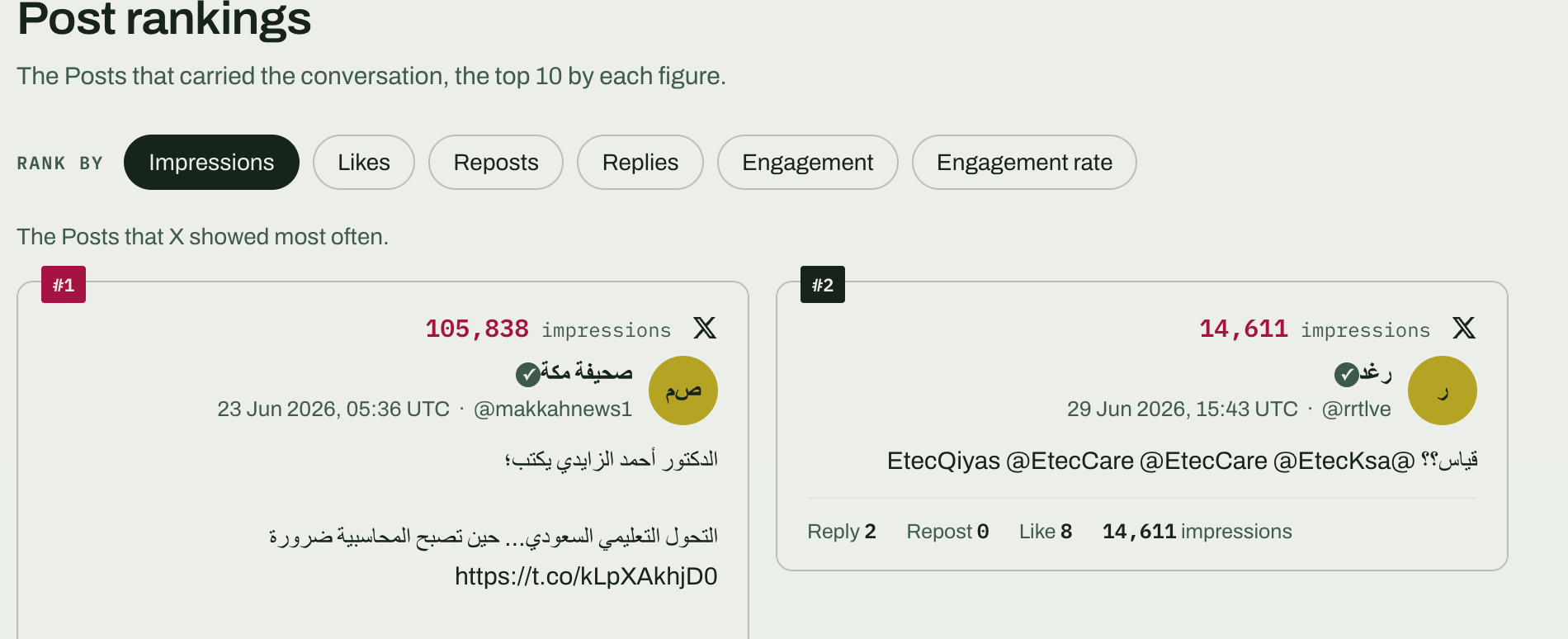
One paragraph, naming the single biggest driver of whatever changed. Usually it is one post, one account or one external event that had nothing to do with you. Finding it takes five minutes with the data sorted by impressions. It is also the part clients repeat to their own boss, which makes it the most valuable paragraph in the document even though it is the shortest.
Show the format split
Break the conversation by format and put the share of volume beside the share of reach. Images against text, links against no links, replies against originals. The finding is always a mismatch. A format that produced 20% of the posts and 60% of the reach is an instruction for next quarter, delivered by the data rather than by your opinion, which is exactly why clients accept it.
Agree the metrics before the work starts
The worst version of this conversation happens at the end, when a client asks for a number nobody was collecting. Agree the four headline figures and the reporting period at the start of the engagement, in writing, and the monthly report becomes a routine rather than a negotiation.
It also protects you. A client who signed off on impressions and unique accounts in month one cannot reasonably ask for follower growth in month six, and if they do, the earlier agreement is the answer.
Make it checkable
State the query, the period and whether reposts are included. Offer the underlying rows on request and mean it. Reports that survive scrutiny are the ones where a sceptical client can verify a figure and find it correct. That single experience buys more trust than any amount of design, and it costs four lines at the bottom of the document.
What to do about bad months
Report them plainly, name the cause and say what changes next. A report that manufactures a positive narrative every month trains the client to discount everything in it, including the months that were genuinely good, and that discount is very hard to reverse once it sets in.
The clients who stay longest are the ones who believe the numbers, and belief is built by reporting a bad month accurately before anyone has to ask about it.
Everything we gather stays within the Twitter compliance rules, and the dataset comes with the report so any figure can be traced back to the posts behind it. Tell us about the account or the campaign and we will scope it.