Share of voice on social media, and why two methods disagree
Share of voice on social media measured by volume says one thing and by reach often the opposite. How to pick a competitor set you can defend.
Share of voice on social media looks like a simple calculation. Your mentions divided by everyone's mentions in your category.
Run it two ways and you often get opposite answers. That contradiction is where the useful information hides.
What share of voice measures
Share of voice is the portion of a conversation that belongs to you compared with your competitors, over a defined period and within a defined set of terms. Two words there do the work: defined and compared. Change the period or the competitor set and the number changes completely, which is why it only means something when both are stated.
Tell us who you want to be measured against and we will scope the comparison before running it.
Tell us who you want to be measured against
Counting posts against counting reach
The two ways of calculating it answer different questions.
By volume, you divide your mentions by total mentions. It tells you who is talked about most.
By reach, you divide your impressions by total impressions. It tells you who is seen most.
A competitor with half your mention volume can have three times your reach, because one large account posted about them. Volume measures how many people spoke. Reach measures how many people were reached. Report both or the number is a half truth.
Choosing a fair competitor set
The temptation is to pick competitors you beat. Everyone does it and everyone knows it is happening. A defensible set has a rule behind it: the three closest by revenue, everyone in the same category on a given list, or whoever the client named in the brief. Write the rule into the report.
If a competitor is excluded because their volume is dominated by something unrelated, say that too. Unexplained exclusions are what make a share of voice figure unusable in a board meeting.
Why the period changes the story
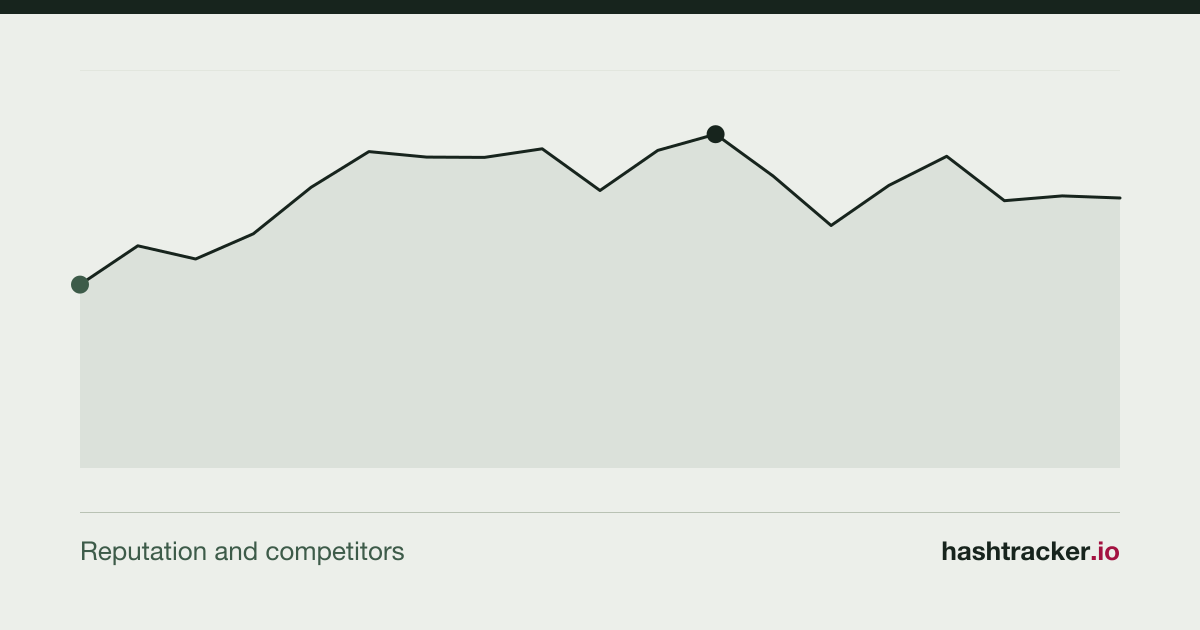
Share of voice over a year smooths out everything interesting. Over a week, one product launch distorts it entirely. Run it monthly and plot the line. The level matters less than the direction, and a competitor climbing steadily is a more important finding than who happens to be ahead this month.
Watch for launches and crises in the underlying data. A spike in a competitor's share because they had an outage is not a win for them, and reporting it as one makes you look like you did not read the mentions.
The version that actually helps
Share of voice on its own is a scoreboard. It tells you the position and not the reason. Put the composition next to it: which formats drove each brand's share, which accounts carried it, whether it came from the brands themselves or from other people talking about them.
That last split is the one worth watching. A brand whose share comes mostly from its own posts is buying its position. A brand whose share comes from other accounts has earned it.
Getting the underlying data right
All of this depends on measuring every brand identically: same operators, same period, same exclusions, same source. Mixing an estimated reach figure for one brand with a counted one for another produces a chart that looks fine and means nothing.
We gather everything within the Twitter compliance rules and hand over the rows, so the comparison can be audited brand by brand. Tell us the category you compete in and we will put the measurement together.